

GAARD NOTES | Q4 2024
The Price-Quality Heuristic is a psychological effect whereby consumers judge the quality of a product based on its price. This association is wrong – and harmful – in investment management. Data from across asset classes reveals a significant inverse relationship between the size of investment fees and the quality of investment returns. In other words, funds with lower fees consistently outperform their higher-fee counterparts across allocation, equity, and fixed income categories. Understanding this trend is pivotal for endowments, foundations, and institutional investors who are reliant on optimizing investment returns to support their organizational goals.
At Gaard Capital, our investment strategy as an OCIO for institutions, endowments, and foundations hinges on the principle that reducing investment fees is essential to enhancing investment quality. Supported by robust data, this principle asserts that lower fees are associated with stronger investment returns. The following graph busts conventional thinking that higher fees correlate with better management and superior returns (Morningstar, 2019).
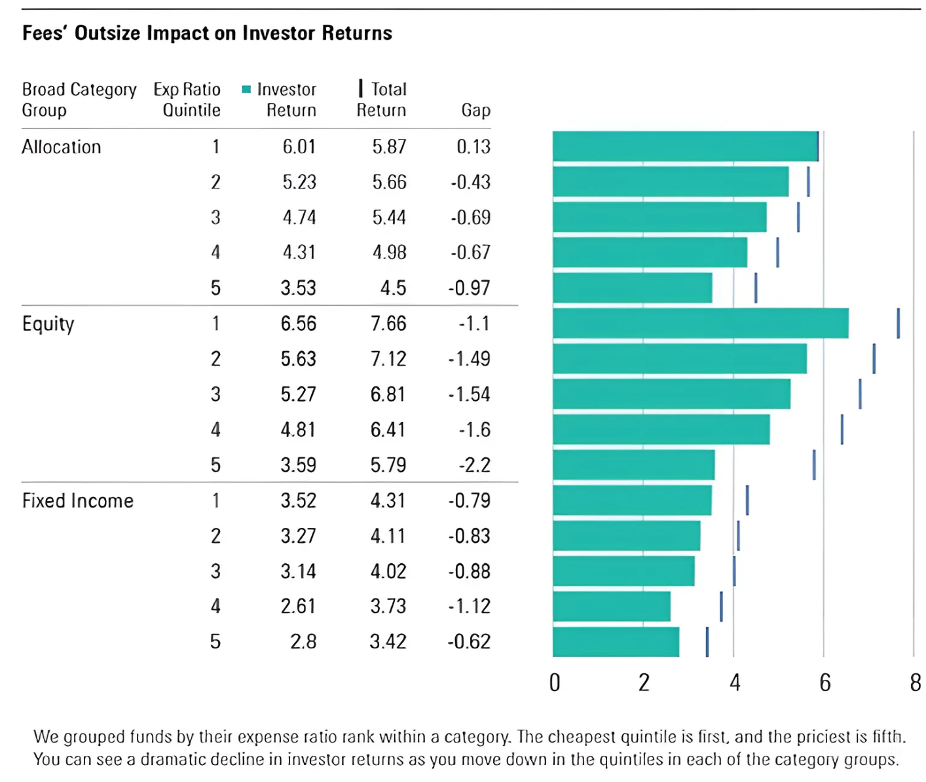
The figure categorizes investors into quintiles based on the expense ratios within their respective asset categories, revealing a consistent pattern: funds with lower fees yield higher returns. This inverse relationship is evident across all examined asset classes, and most notably in equity funds.
In allocation funds, the lowest fee quintile (Quintile 1) records an investor return of 5.87, significantly higher than the 4.5% seen in the highest fee quintile (Quintile 5). This discrepancy highlights the adverse impact of higher fees on the net quality of investment returns, supporting the argument that lower fees enhance investment performance (Jones, 2018). The investor return gap is a positive 0.13 for the low cost funds relative to -0.97 for the expensive funds.
The trend is stark in equity funds, where the lowest fee quintile surpasses the highest by 1.87 percentage points (7.66% vs. 5.79%). This sizable gap underscores how excessive fees can erode returns, diminishing the overall quality of the investment (Fama & French, 2010). The investor return gap is -1.1% for the low cost funds and a whopping -2.2% for the expensive funds.
Similar observations in fixed income funds show returns of 4.31% in the lowest fee quintile versus 3.42% in the highest. Although the difference is less pronounced than in equities, it nevertheless consistently supports the correlation between lower fees and higher investment quality (Chen, 2019). The low and high cost funds’ investor return gap is about the same (-0.79 and -0.62).
For endowments and foundations, which operate under stringent budget constraints and depend heavily on investment income, the impact of fees extends beyond mere portfolio performance; it directly influences the organization’s ability to fund its mission. Electing into lower-fee funds is, therefore, crucial for enhancing their financial health and ensuring that more capital is directed towards meaningful, mission-critical initiatives rather than to pay out on corrosive administrative expenses.
Gaard Capital prioritizes funds with lower expense ratios, embedding cost-efficiency within our investment screening process. This strategy aligns with the stewardship responsibilities of organizations, ensuring that every dollar is utilized effectively (Smith, 2020).
We actively educate board members and stakeholders about the critical impact of fees on investment quality, promoting informed decision-making that prioritizes financial efficiency and strategic investment planning (Johnson & Green, 2021).
The data conclusively demonstrates that lower fees can produce higher investment quality. For non-profit endowments, leveraging this insight is essential for fiscal responsibility, maximizing financial resources and directing resources toward realizing a fund’s mission. Gaard Capital remains committed to serving institutions ensure that fee efficiency constitutes a successful and winning measure in their investment strategy.
Bogle, J. (2017). The little book of common sense investing: The only way to guarantee your fair share of stock market returns. Wiley.
Chen, H. (2019). The impact of fees on investment returns. Journal of Financial Economics, 132(3), 124–143.
Fama, E. F., & French, K. R. (2010). Luck versus skill in the cross-section of mutual fund returns. The Journal of Finance, 65(5), 1915–1947.
Johnson, M., & Green, T. (2021). Educating investors: Strategies for improving financial literacy. Journal of Wealth Management, 24(2), 58–64.
Jones, R. C. (2018). Fee structures and mutual fund performance. Financial Analysts Journal, 74(1), 33–48.
Morningstar. (2019). Investor returns and fund fees. https://www.morningstar.com/
Smith, A. (2020). Strategic fee management and non-profit endowments. Nonprofit Management & Leadership, 31(2), 305–322.